


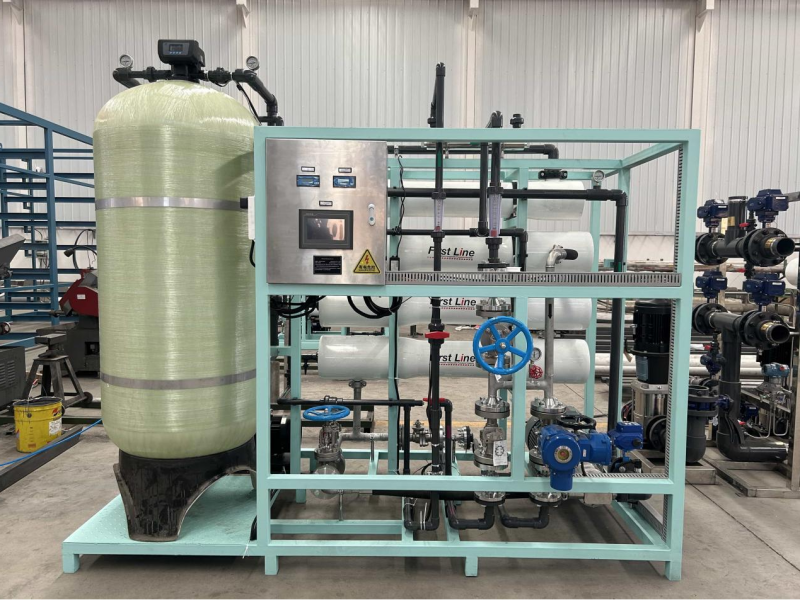

The Correct Procurement Process for Reverse Osmosis (RO) Equipment, from Small 1-Ton Units to Large-Scale Water Treatment Equipment
When purchasing RO equipment, salespeople will ask how many units you need. Here's a brief overview: The permeate flow rate of RO equipment is determined by the Ro Membrane. There are three types of RO membranes: 4-foot and 8-inch, typically installed in RO membrane housings. RO membrane housings come in two sizes: 4-foot and 8-inch. The main materials are FRP and stainless steel, and they are typically one-shell-one-core or one-shell-two-core (one shell with two RO membranes). Permeate flow rate can be calculated by counting the number of membrane housings.
To understand the permeate flow rate of a single-stage Ro System, first determine whether it's a 4-foot or 8-foot membrane. Then, count the total number of RO membrane housings to determine if the RO membrane is a single-core or dual-core housing, and then calculate the equipment's permeate flow rate.
Generally, 4-foot RO membranes are used.
A single industrial-grade membrane with a diameter of 4 feet has a water production rate of 0.25 t/h. Typically, what we see is the membrane housing of the equipment. We can instruct the water purification equipment manufacturer to install and remove the RO membrane on-site. A 1-ton single-stage Reverse Osmosis unit has a water production rate of 0.25 t/h * 4 = 1 t/h. This includes the application housing and key control module housing.

Generally, an 8-foot reverse osmosis membrane is used.
A single industrial-grade membrane with a diameter of 8 feet has a water production rate of 1 t/h. When a high water production rate is required, the manufacturer will configure 8-foot membranes. This not only results in a high water production rate but also a smaller number of membranes, leading to a compact structure and aesthetically pleasing appearance. A 6-ton single-stage reverse osmosis unit has a water production rate of 1 t/h * 6. Three one-shell two-core membrane housings and six 8-foot reverse osmosis membranes can meet the requirements.
A 1-ton reverse osmosis unit generally selects a 4-foot reverse osmosis membrane. This 1-ton reverse osmosis unit offers high-precision filtration, allowing only water to pass through. It efficiently removes suspended solids, colloidal solutions, microorganisms, and various salts, boasting a high desalination rate, long service life, and low operating costs. An online real-time monitoring system allows for continuous monitoring of system operation, ensuring the facility's performance. Despite its smaller tonnage and production capacity, this high-quality water treatment equipment fully guarantees that the water meets our daily drinking water standards. The fully automatic system control, with the option of a touchscreen display, ensures convenient and user-friendly operation. Scientifically designed solutions can be tailored to individual user specifications.